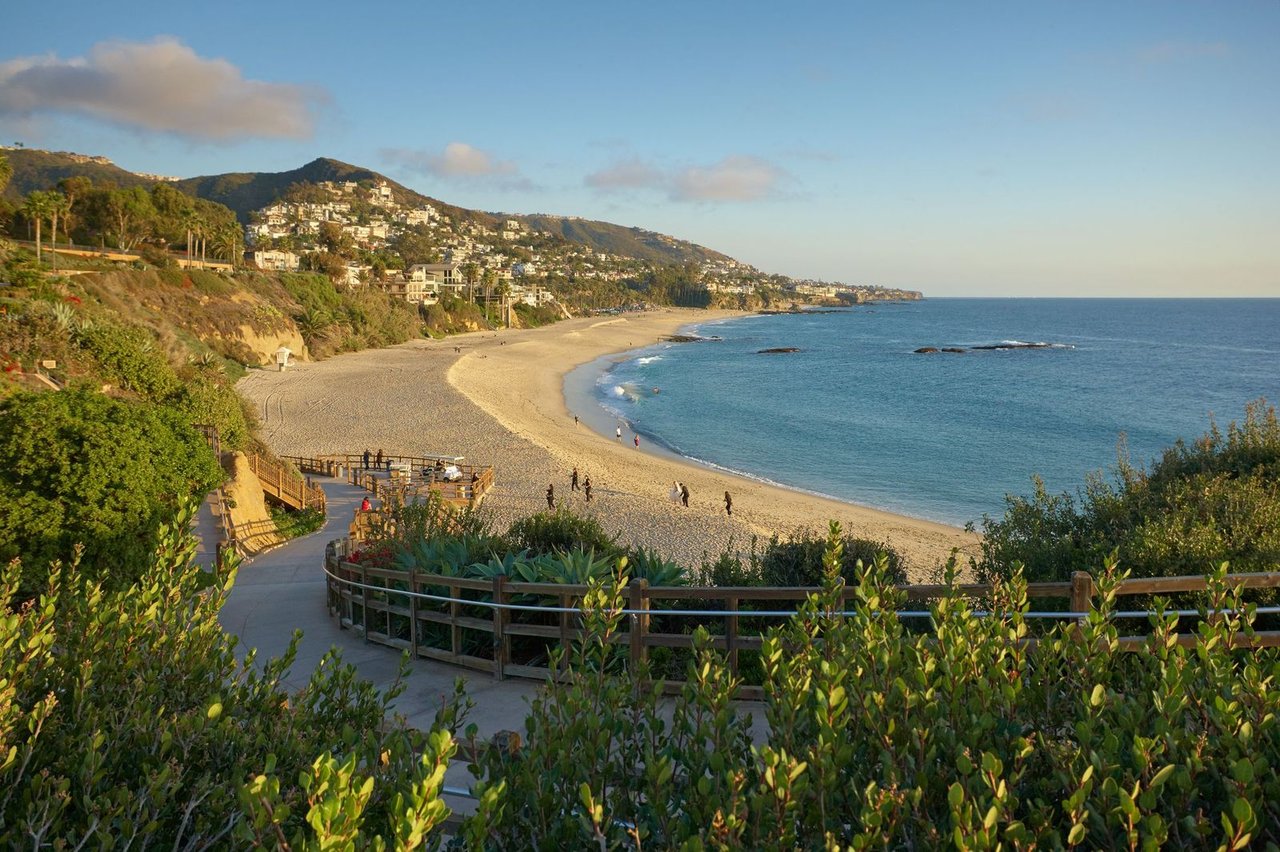
Laguna Beach, CA sits in Orange County, roughly 40 miles south of Los Angeles. The geography here is unlike most coastal cities - canyon roads drop down toward the Pacific, and houses climb directly into the hillsides. It's dramatic, and it comes with a set of purchase considerations you won't run into buying something flat in Irvine.
If you're serious about buying here, you need to understand slope foundations, coastal regulations, and what a high-end pricing tier actually means for your offer strategy before you ever walk through a door.
The median sale price in the Laguna Beach housing market right now is around $3,100,000. Homes are averaging about 77 days on market before they sell - that's considerably more breathing room than you'd get in most inland Southern California markets. There are roughly 162 active listings with about 35 sales per month, which puts the city at 4.6 months of supply. Sellers are getting an average of 98.1% of their list price, and about 20% of homes are still selling above asking.
At 4.6 months of supply, this market leans slightly toward sellers while staying relatively balanced. You have enough time to do proper due diligence - but don't confuse that with having unlimited runway on a well-priced property.
Get your financing sorted early. The nearly 80-day average market time does give you leverage on homes that have been sitting, but anything turnkey with an ocean view won't wait for you to figure out your lender situation.
The inventory here is mostly custom-built single-family homes, with a smaller selection of attached units mixed in. If you're hoping to find a deal at the lower end of the price spectrum, you'll be disappointed - the $3.1 million median reflects a market that skews heavily toward luxury. What you will find is a genuine range of architectural character: mid-century houses, modern new construction, historic cottages that have been updated over the decades. Each type carries its own maintenance profile and insurance implications, and those differences matter here more than in most markets.
Detached houses dominate the upper end, especially anything with unobstructed water views or a meaningful lot. Custom architecture and outdoor living spaces designed for coastal conditions are the norm. What buyers sometimes underestimate is the ongoing cost - hillside retaining walls, salt-air wear on exterior materials, and the general demands of a house built into a slope all require a real annual maintenance budget.
Attached housing gives you a lower entry point, though "lower" in this market still means prices routinely exceeding $1 million. The trade-off is less exterior maintenance responsibility, which is a genuine draw for buyers looking at this as a second home.
Before you remove your contingencies, read the HOA documents carefully. Monthly dues can be significant, and every dollar of them counts against you in mortgage underwriting.
The city stretches across several distinct geographic zones - from the immediate coastline up through the canyon ridges. Identifying the best neighborhoods in Laguna Beach for your lifestyle depends on whether you prioritize ocean access or canyon privacy. Most of the city falls under ZIP code 92651, with 92637 also appearing in some local property records. A few landmarks are worth knowing as orientation points: Heisler Park and its recognizable gazebo sit near the main village, the Pirate Tower on Victoria Beach marks the southern coastal stretch, and the 1935 gate at Forest and Park Avenues is the entry point to downtown. These aren't just scenic details - they define how different pockets of the city feel and function.
Properties directly on the sand carry the highest premiums in the city and face the strictest coastal building codes. Hillside homes offer panoramic views, but slope stability and drainage need serious evaluation before you get attached to any of them.
Work with inspectors who actually specialize in coastal geology. Foundation and soil inspections aren't optional on an inclined lot - they're standard practice.
Homes near the downtown village put you within walking distance of restaurants, galleries, and the main beaches. The lots tend to be smaller, and the houses are often older cottages that have been updated over time. One practical thing to verify before you buy: how many dedicated off-street parking spaces come with the property. Street parking in the central area gets genuinely difficult during summer months.
Laguna Beach sits entirely within Orange County and is part of the Los Angeles-Long Beach-Anaheim metro area. Pacific Coast Highway and Laguna Canyon Road are the two primary connections to the rest of the region - they're the routes commuters use to reach Irvine, Newport Beach, and points beyond. Drive times shift considerably with summer tourism traffic along the coast, which is something you'll want to experience firsthand before you commit to a property. This seasonal congestion is an important factor when weighing the pros and cons of living in Laguna Beach.
John Wayne Airport in Santa Ana is the closest major airport, sitting roughly 10 to 16 miles away depending on where exactly in town you're starting from. Under normal traffic, you're looking at a 20 to 25 minute drive. For residents who travel frequently, that's a meaningful convenience.
The cost of living in Laguna Beach runs anywhere from 42% to 226% above the national average, depending on the index and how it's weighted. Housing is the primary driver of that gap, followed by local services and transportation.
According to 2024 data, the city had a population of roughly 22,564 to 22,710 residents, with a median age of about 53.9 years. The median household income was $143,843 in 2024. These figures highlight the area's economic profile and the financial qualifications lenders will be evaluating when you apply for a jumbo mortgage here.
California property taxes start at 1% of the purchase price, plus any local voter-approved bonds. On a $3.1 million home, that's a base tax bill of at least $31,000 per year - and that figure resets to your actual purchase price, not the prior owner's.
Insurance deserves its own conversation. Fire risk and slope exposure can limit your coverage options and push premiums significantly higher than you might expect. Get quotes during your contingency period, not after.
This market has a high degree of specialization, and the gap between an agent who knows it and one who doesn't is real. Coastal regulations, hillside foundation issues, and local pricing nuances are not things you learn from a general Orange County practice. You will want the best real estate agent in Laguna Beach to handle these specific challenges.
Real estate commissions in California are negotiated between the seller, the buyer, and their respective brokers. Have that conversation about compensation structures and representation agreements before you start touring homes - not after you've fallen in love with something.
Ask specifically about recent transaction volume within Laguna Beach. An agent who works primarily inland may have no experience with the local design review board, which is a gap that costs you time and money.
Ask them how they handle inspections on older or hillside properties, and who they call. Their network of specialized local inspectors is one of the more tangible things they bring to the table.
The process starts with financing. Anyone selling a home in Laguna Beach expects a pre-approval letter or documented proof of funds with any offer - submitting without one signals that you're not serious. Once your offer is accepted, escrow typically runs 30 to 45 days, covering inspections, appraisals, and final loan underwriting.
A general home inspection covers the basic systems, but buyers in Laguna Beach routinely order more. Roof, sewer line, and geological inspections are common here, and they're common for good reason.
If the inspections turn up issues, you can request repairs or a credit. The seller isn't required to agree. At that point you'll need to decide whether to move forward or cancel - and having a clear sense of your walk-away number before that moment arrives makes the decision a lot easier.
It depends on the property and the level of competition at that moment. Cash offers are common in the luxury segment, but many buyers do finance their purchases successfully. With homes averaging 77 days on market, financed buyers have real room to negotiate - it's not the all-cash-or-nothing environment you might assume.
It can be both difficult and expensive. Many carriers have tightened underwriting rules for California properties in high-fire-risk zones. Get quotes from multiple providers during your inspection period - you want to confirm that coverage is actually available before you waive your contingencies.
It depends on the specific zoning of the property. The city enforces regulations on short-term rentals, and many residential neighborhoods prohibit leases under 30 days. Verify the local ordinance for your exact address before you buy anything with that intention.
Significant ones. The local design review board evaluates how proposed changes affect neighborhood character and views. The Coastal Commission adds a separate layer, focused on environmental and shoreline impacts. If you're planning major exterior changes, build extended permitting timelines into your expectations from the start.
Properties near the 1935 gate at Forest and Park Avenues put you right at the edge of downtown. Homes surrounding Heisler Park also give you excellent walkability to the village center and the sand. Both areas tend to have smaller lots and a higher price per square foot as a result.
Any exterior changes on a historic property go through local review boards and must maintain the structure's original character - that's a firm constraint, not a suggestion. On the financial incentives side, talk to a tax professional. That's not a question I'd answer for you, and you shouldn't rely on anyone who does without knowing your specific situation.
23,477 people live in Laguna Beach, where the median age is 52.8 and the average individual income is $114,706. Data provided by the U.S. Census Bureau.
Total Population
Median Age
Population Density Population Density This is the number of people per square mile in a neighborhood.
Average individual Income
There's plenty to do around Laguna Beach, including shopping, dining, nightlife, parks, and more. Data provided by Walk Score and Yelp.
Explore popular things to do in the area, including Webb Margie Swimwear, Cantonwine Gertrude, and Riga.
| Name | Category | Distance | Reviews |
Ratings by
Yelp
|
|---|---|---|---|---|
| Shopping | 0.33 miles | 0 reviews | 0/5 stars | |
| Shopping | 0.33 miles | 0 reviews | 0/5 stars | |
| Shopping | 1.22 miles | 1 review | 5/5 stars | |
| Active | 0.17 miles | 0 reviews | 0/5 stars | |
| Active | 0.33 miles | 1 review | 5/5 stars | |
| Active | 0.33 miles | 0 reviews | 0/5 stars | |
| Active | 0.33 miles | 0 reviews | 0/5 stars | |
| Active | 0.33 miles | 0 reviews | 0/5 stars | |
| Active | 0.47 miles | 0 reviews | 0/5 stars | |
| Active | 1.1 miles | 0 reviews | 0/5 stars | |
| Beauty | 0.33 miles | 0 reviews | 0/5 stars | |
| Beauty | 0.33 miles | 0 reviews | 0/5 stars | |
| Beauty | 0.33 miles | 1 review | 1/5 stars | |
| Beauty | 0.33 miles | 0 reviews | 0/5 stars | |
| Beauty | 0.33 miles | 0 reviews | 0/5 stars | |
| Beauty | 0.33 miles | 0 reviews | 0/5 stars | |
| Beauty | 0.33 miles | 0 reviews | 0/5 stars | |
| Beauty | 0.33 miles | 40 reviews | 4.2/5 stars | |
| Beauty | 1.17 miles | 0 reviews | 0/5 stars | |
| Beauty | 1.17 miles | 1 review | 5/5 stars | |
| Beauty | 1.17 miles | 0 reviews | 0/5 stars | |
| Beauty | 1.22 miles | 0 reviews | 0/5 stars | |
| Beauty | 1.23 miles | 4 reviews | 4.5/5 stars | |
| Beauty | 1.28 miles | 3 reviews | 5/5 stars | |
|
|
||||
|
|
||||
|
|
||||
|
|
||||
|
|
||||
|
|
Laguna Beach has 11,141 households, with an average household size of 2.1. Data provided by the U.S. Census Bureau. Here’s what the people living in Laguna Beach do for work — and how long it takes them to get there. Data provided by the U.S. Census Bureau. 23,477 people call Laguna Beach home. The population density is 1,064 and the largest age group is Data provided by the U.S. Census Bureau.
Total Population
Population Density Population Density This is the number of people per square mile in a neighborhood.
Median Age
Men vs Women
Population by Age Group
0-9 Years
10-17 Years
18-24 Years
25-64 Years
65-74 Years
75+ Years
Education Level
Total Households
Average Household Size
Average individual Income
Households with Children
With Children:
Without Children:
Marital Status
Blue vs White Collar Workers
Blue Collar:
White Collar: