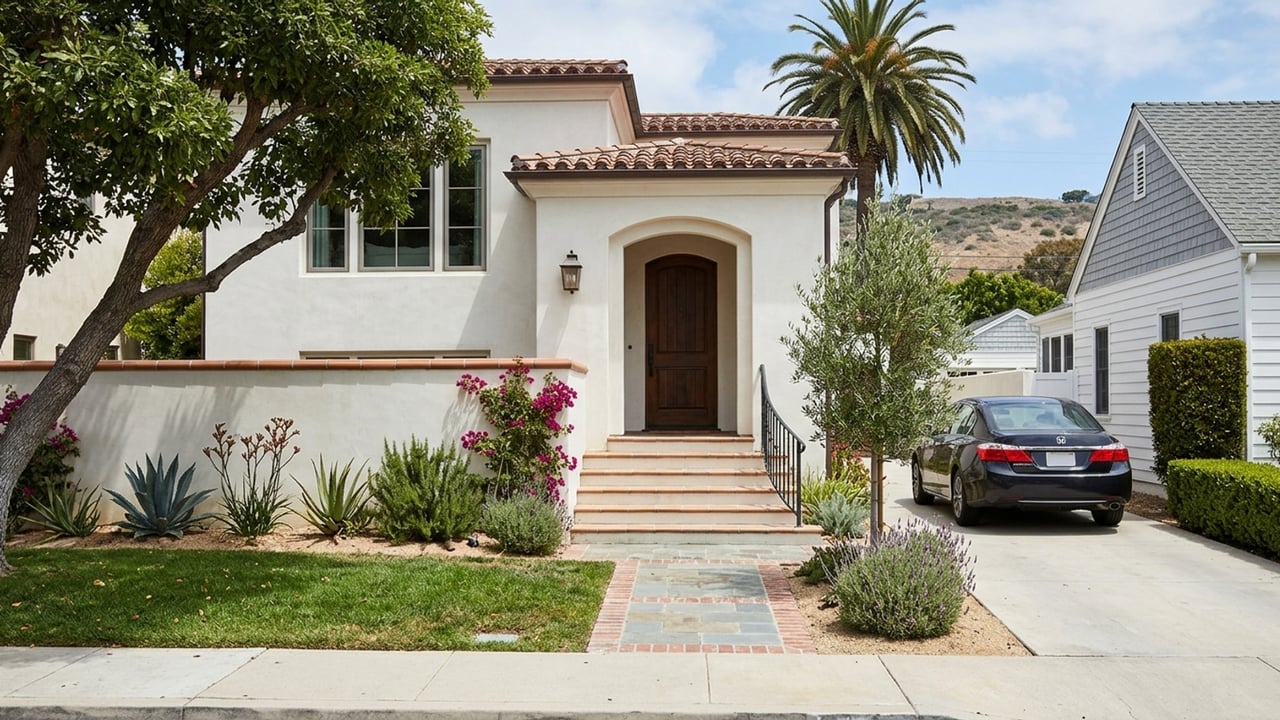
In Newport Beach, the safety question that most affects a buyer's money is settled at the address level by flood and fire hazard maps, not by the citywide crime average. A market where all homes recently sold at a median 96.9% of list price with 4.2 months of supply gives buyers the time and negotiating room to check flood zones, hazard disclosures, and insurance quotes before they commit.
Local hazards hit your specific parcel and dictate actual costs. Official town-level public safety data, natural hazard mapping, and the specific checks to run on a property during escrow are all covered below.
Key takeaway
Newport Beach's crime picture is best judged from official town-level figures, but for a buyer, the bigger safety question is usually the specific address: tidal flooding, wildfire hazard zones, and what insuring the home will cost. With the median home taking roughly 65 days to sell, you typically have time to pull the flood map, hazard disclosure, and insurance quotes before committing. If you're visiting rather than buying, lifeguard coverage and beach water-quality reports matter more.
Who this guide is for
You're considering buying a home in Newport Beach and want to see what the official crime data and natural-hazard records show before you narrow your search to a specific address.
Newport Beach crime rates and trends
The FBI's Uniform Crime Reporting data for 2024 shows Newport Beach's violent crime rate at 251.8 per 100,000 people and its property crime rate at 1,872.6 per 100,000 people.
The Newport Beach Police Department handles law enforcement for the city and publishes annual and monthly crime statistics on its website. If your concern is crime across the city, those official reports show the overall incident volume. Property-specific risks are detailed separately in natural hazard disclosures.
Violent and property crime rates
The police department publishes city-wide crime statistics in the National Incident-Based Reporting System format, tracking offenses across the entire municipality. Property offenses and violent offenses are counted separately, giving residents a clear view of what each category covers.
Official annual figures describe the whole city and lag by a year or more. They say nothing about a specific street, and this page deliberately does not break them down by area. To check recent town-level incident activity, review CrimeMapping.com and the police department's published statistics.
How the rates compare with California and U.S. averages
The California Department of Justice reported a statewide violent crime rate of 480.3 per 100,000 population in 2024, down from 511 in 2023. The statewide property crime rate was 2,082.7 per 100,000 population for that same year. Nationally, the FBI reported 359.1 violent crimes and 1,760.1 property crimes per 100,000 inhabitants in 2024.
Newport Beach's reported rates for both categories fall below those state and national benchmarks. What you give up when relying on these per-capita rates is the visitor effect. In a coastal city that draws millions of visitors, incidents involving non-residents still divide by the resident count, so compare like-for-like years and sources before drawing broad conclusions.
Police, fire, and lifeguard services in Newport Beach
The Newport Beach Police Department provides law enforcement across the city, while the Newport Beach Fire Department handles fire protection and emergency medical services. For harbor and ocean rescue, the fire department's Marine Operations Division staffs the lifeguard towers and manages water safety programs.
Residents receive emergency notifications through the city's alert systems. Sign up for official emergency alerts for the city to stay informed about local incidents, road closures, or evacuation notices.
Natural hazards that affect Newport Beach homes
Southern California's seismic exposure means earthquakes are a standard part of property evaluation. The Newport-Inglewood Fault Zone, an active right-lateral strike-slip fault that produced the 1933 Long Beach earthquake, extends through the southwestern portion of Newport Beach.
The city maps this fault in accordance with California Geological Survey guidelines and notes the area is also underlain by the blind San Joaquin Hills fault. If the home you're considering sits close to the harbor or ocean at low elevation, flooding becomes a primary concern on top of that.
Coastal flooding and high tides
The City of Newport Beach actively issues king tide advisories warning residents that evening high tides may cause localized flooding in low-lying waterfront areas. In October 2026, the city council declared a local emergency ahead of high king tides, activating the Emergency Operations Center and reinforcing protective beach berms.
Mortgage lenders use FEMA flood hazard maps to determine whether flood insurance is required. Special Flood Hazard Areas in Newport Beach carry designations like Zone A, AE, AO, and VE, all of which require flood insurance if you have a federally backed mortgage. The limitation of relying solely on the map is that FEMA models update slowly. A home outside a mapped zone can still take water during king tides and storms.
Wildfire hazard zones
Parts of the city's hillside and open-space edges fall into CAL FIRE Fire Hazard Severity Zones. These designations map the risk of wildland fires based on vegetation, topography, and weather patterns. Check the official CAL FIRE map for the specific parcel you want to buy.
A high-hazard designation affects insurance availability and price. The catch is that insurers may have their own internal risk models that limit coverage even if the state map places the home in a moderate zone.
How to check a specific Newport Beach address
Buyers have room to run hazard and insurance checks without losing the home, especially when offers that keep inspection and insurance contingencies in place are standard. With only 8.9% of all homes selling above list price recently, you're not forced to waive your right to investigate the property.
The median sale price for all homes rose 13.2% year over year to roughly $3,848,000, but single-family homes gained 6.6% while condos fell 0.9%. That headline gain reflects which homes sold rather than every home gaining value uniformly, and it leaves room to negotiate if you turn up an issue.
Read the natural hazard disclosure and flood map
California sellers must disclose whether a home sits in mapped flood, fire, earthquake fault, and seismic hazard zones. Read the Natural Hazard Disclosure report in full and confirm each zone against the official CAL FIRE, California Geological Survey, and FEMA maps. Look up the exact parcel on the FEMA Flood Map Service Center before making an offer.
The California Geological Survey's map shows that areas west of Coast Highway from the Santa Ana River to Bayside Drive, plus the Back Bay area, are within tsunami inundation zones. What these reports don't tell you is the property's actual history. Disclosure reports show mapped zones, not what has happened at the house. Ask the seller in writing about past flooding, water intrusion, and insurance claims, and request a CLUE report.
Price insurance before contingencies end
Get homeowners, flood, and earthquake insurance quotes before removing the insurance contingency. For a condo purchase, review the HOA master policy first, then ask the association for its declarations on flood and earthquake coverage, deductibles, and any pending special assessments. Condos offer a lower entry price where building insurance is handled by an HOA, and they sit on the market for a median 70 days.
Condo sellers still collect 97.6% of their list price, so an unexpected insurance or HOA assessment cost is harder to negotiate back. Insurance quotes can change between offer and closing, and some carriers limit new policies in high-hazard zones. Lock in coverage before you remove the contingency. Tim Smith Real Estate Group can help line up these disclosures and timelines during your escrow period.
What living in Newport Beach is like
Newport Beach centers around its massive recreational harbor, miles of oceanfront beaches, and extensive coastal access. The city maintains public docks, boardwalks, and marine facilities that define the daily routine for residents.
For the full cost and lifestyle picture beyond safety, review the pros and cons of living in Newport Beach. You can also compare a cash offer or check the Newport Beach housing market trends to see how local amenities affect property values.
At a glance
- All homes, median sale price: $3,848,167, up 13.2% year over year (90 days ending 2026-09-30)
- All homes, homes sold: 284; median days on market: 65 (90 days ending 2026-09-30)
- All homes, sale-to-list ratio: 96.9%; sold above list: 8.9% (90 days ending 2026-09-30)
- All homes, months of supply: 4.2; inventory: 391; median price per sq ft: $1,642 (90 days ending 2026-09-30)
- Single-family, median sale price: $4,810,582, up 6.6% year over year; 200 sold (90 days ending 2026-09-30)
- Single-family, median days on market: 65; sale-to-list: 96.7%; sold above list: 9.1% (90 days ending 2026-09-30)
- Single-family, months of supply: 3.8; inventory: 251; median price per sq ft: $1,779 (90 days ending 2026-09-30)
- Condo, median sale price: $1,894,805, down 0.9% year over year; 58 sold (90 days ending 2026-09-30)
- Condo, median days on market: 70; sale-to-list: 97.6%; sold above list: 8.8% (90 days ending 2026-09-30)
- Condo, months of supply: 4.5; inventory: 85; median price per sq ft: $1,115 (90 days ending 2026-09-30)
Newport Beach safety FAQs
How does Newport Beach's crime rate compare with the rest of Orange County?
The FBI reported Newport Beach's violent crime rate at 251.8 per 100,000 people and its property crime rate at 1,872.6 per 100,000 people in 2024. Check the California Department of Justice's OpenJustice portal for the latest Orange County aggregate rates to calculate the percentage difference.
Is it safe to swim at Newport Beach?
The Newport Beach Fire Department's Marine Operations Division advises swimming at a lifeguard-protected beach, noting that rip currents are the leading surf hazard. Water quality is generally high, with 32 of 36 bay and ocean testing sites earning an A or A+ grade during a recent summer season, though the OC Health Care Agency does issue periodic closures for sewage spills. Swim near a staffed lifeguard tower and check the day's closure list before you get in.
Do I need flood insurance in Newport Beach?
Yes, if you have a federally backed mortgage and the home sits in a FEMA Special Flood Hazard Area. The city notes that ongoing FEMA map updates propose placing thousands of additional properties into designated flood hazard zones, which triggers mandatory insurance. Get a quote for the specific parcel during escrow. The city regularly issues high-tide flooding advisories even outside mapped zones, so don't assume a zone boundary tells the whole story.
Is Newport Beach in a tsunami hazard zone?
Yes. The California Geological Survey's Tsunami Hazard Area map shows areas west of Coast Highway from the Santa Ana River to Bayside Drive and the Back Bay area are within tsunami inundation zones. Look up the parcel and note the evacuation routes.
Is Newport Beach safe right now?
Check official alert channels for real-time conditions. Sign up for alerts before moving to receive city emergency notifications and county updates. You can also review the Newport Beach Police Department's updates and CrimeMapping.com for recent town-level activity.
Is Newport Beach safe for tourists?
Visitors have access to the same police, fire, and medical services as residents, including lifeguard-staffed beaches managed by the Marine Operations Division. Follow posted beach flags and lifeguard instructions, and check official water-quality closures before swimming.
Is Newport Beach, California wealthy?
The median sale price for all homes in the city was roughly $3,848,000 over a recent 90-day period. That reflects the high cost of coastal real estate in the area.
Is Newport Beach expensive to live in?
Yes. The all-homes median price per square foot was recently $1,642, with condos offering a lower entry point at a median of roughly $1,894,000. Review the pros and cons of living in Newport Beach to understand ongoing costs like property taxes and utilities.
Sources
- Redfin: Data Center
- Newport Beach Police Department: Crime Statistics
- HomeSnacks: Newport Beach Crime
- California Department of Justice: Crime in California 2024
- FBI: UCR Summary of Reported Crimes in the Nation 2024
- Newport Beach Fire Department: Marine Operations Division
- Newport Beach Indy: Heal the Bay Report Card
- City of Newport Beach: News
- City of Newport Beach: FEMA Flood Insurance Rate Map Zone Definitions
- City of Newport Beach: Flood Map FAQs
- City of Newport Beach: Earthquakes
- California Department of Conservation: CGS Issues New Tsunami Hazard Maps for Orange County
- California Legislative Information: Civil Code 1103