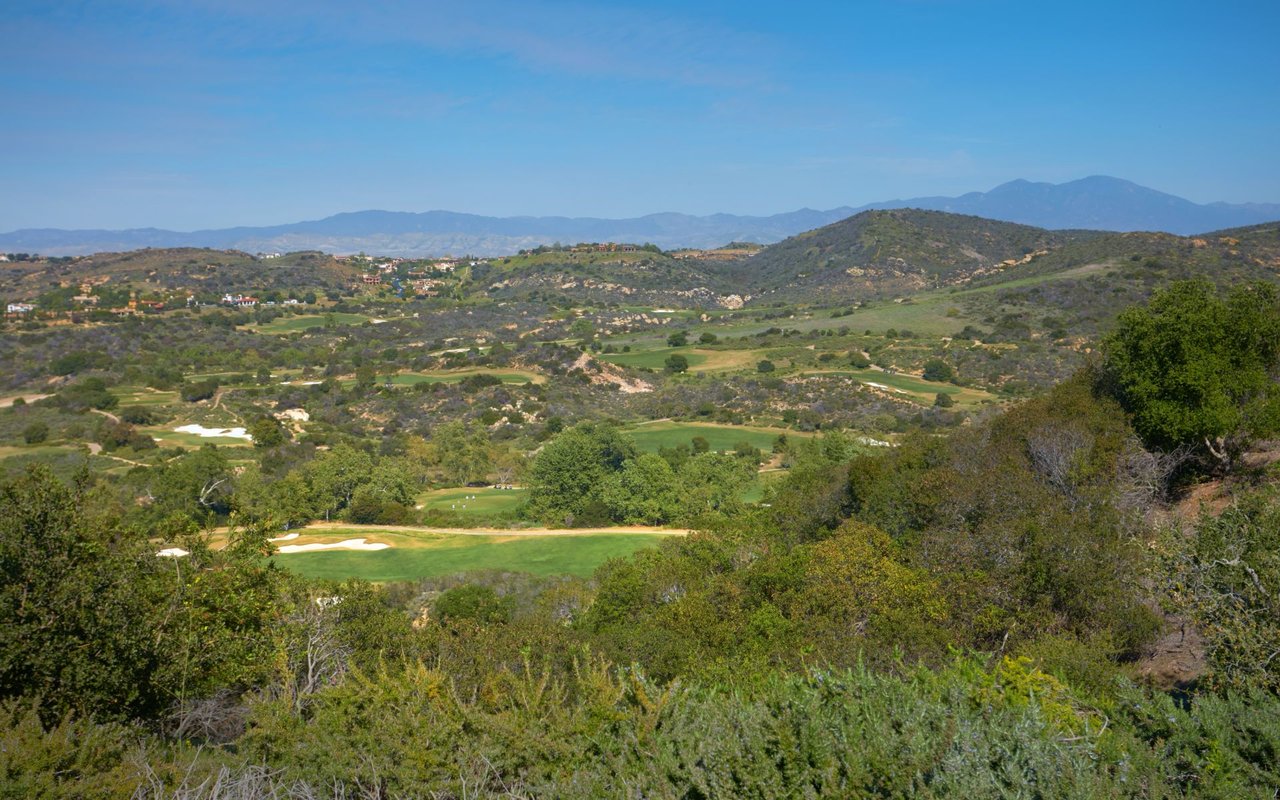
Shady Canyon is a private, guard-gated estate community in southern Irvine, set among rolling hills, preserved canyon land, and the Shady Canyon Golf Club. Unlike Irvine’s denser master-planned villages, Shady Canyon was conceived as a low-density residential and golf community where large homesites, natural landforms, restrained streetscapes, and custom architecture shape the experience.
The scale helps explain the difference. Robert Hidey Architects’ master plan identifies 297 residential dwellings across approximately 1,070 acres, with custom homes and merchant-built single-family residences integrated around the private golf course and open space. City zoning for Planning Area 22 likewise describes Shady Canyon as a privately gated, low-density residential community organized around an 18-hole golf course.
For buyers, Shady Canyon is less about choosing a floor plan and more about choosing a site. Canyon orientation, golf course position, elevation, privacy, natural open space, architectural pedigree, and renovation history can all change the value and daily experience of two homes within the same gates.
Shady Canyon occupies the highest end of the Irvine real estate market. Inventory is naturally limited by the community’s low-density plan, and much of the housing stock consists of custom or highly individualized estates rather than interchangeable production homes.
That makes neighborhood-wide averages less useful than they may be elsewhere in Irvine. A custom estate on a large view lot, a golf-oriented residence, and a smaller merchant-built home can differ substantially in land, architecture, condition, privacy, and replacement cost.
Because the community contains both one-of-a-kind estates and more consistently planned residences, the most relevant comparable sale is not always the closest house geographically. Buyers and sellers need to understand which properties genuinely compete with one another based on homesite, view, scale, architectural quality, and condition.
Lot quality is fundamental. Buyers often weigh elevation, canyon or city-light views, golf course exposure, privacy from neighboring homes, usable outdoor space, and the relationship between the residence and surrounding preserved land.
Architecture is another major component. Many Shady Canyon estates were designed as complete architectural compositions, with courtyards, loggias, guest casitas, stonework, mature landscaping, pools, and indoor-outdoor rooms intended to fit the terrain. The quality of the original design—and how thoughtfully later renovations respect it—can matter as much as raw square footage.
Tim Smith Real Estate Group has direct transaction experience in this market. The team represented the seller of 121 Canyon Creek in a $14.75 million sale that, according to TSREG’s published success record, established a new benchmark at the time for a non-view home in Shady Canyon.
Specific opportunities can be difficult to replace. Buyers seeking a particular combination—single-level living, a large flat lawn, a protected canyon outlook, golf course proximity, newer construction, or a fully renovated estate—may wait for the right property rather than simply choose from what is available.
That scarcity makes property-specific comparable sales especially important. In Shady Canyon, value is often better understood through lot, location, architecture, condition, and view than by price per square foot alone.
Architecture is one of Shady Canyon’s defining features. The City of Irvine’s planning framework calls for a classic rural or country expression influenced by early California and European architecture, with warm earth tones, clay or slate roof materials, stucco and plaster, stone, brick, wood, and landscape elements integrated into the homes.
The goal was not visual uniformity. It was architectural harmony with the hills. The community’s original planning and landscape teams emphasized homes that respond to their individual sites rather than dominate them, helping explain the low profiles, courtyards, textured materials, natural landscaping, and indoor-outdoor spaces found throughout Shady Canyon.
Shady Canyon’s custom estates represent the community at its most individual. Larger homesites allowed architects to respond directly to topography, rock outcroppings, canyon edges, golf course views, and privacy.
As a result, buyers encounter homes with distinctly different plans and design histories. Mediterranean, Tuscan, Santa Barbara, Spanish, Provençal, and other early California or European-influenced expressions appear throughout the community, often with extensive stonework, tile roofs, courtyards, loggias, detached guest accommodations, pools, and landscaped grounds.
The community also includes merchant-built detached residences, giving Shady Canyon more variety than its reputation as an exclusively custom-home enclave might suggest. Those homes can offer greater consistency in original planning and scale, while the fully custom estates tend to make lot selection, architect, builder, and individual design history more important to valuation. Robert Hidey Architects’ master plan specifically incorporated both custom homes and merchant-built single-family residences.
The site itself should be considered part of the architecture. A residence designed around a canyon edge or long view may live very differently from a similarly sized home on a more enclosed interior lot.
Shady Canyon is now mature enough that renovation history deserves close attention. Buyers should understand not only when a home was built, but which systems, finishes, roofs, windows, landscaping, pools, and mechanical components have been updated since original construction.
Major exterior changes are also not simply a private design decision. City permitting requirements apply, and community architectural review can add another layer of approval. For buyers considering substantial remodeling or redevelopment, feasibility should be evaluated before assuming a desired addition, exterior redesign, or landscape change will be approved.
The private Shady Canyon Golf Club is visually and geographically central to the community. The club dates to 2002 and is anchored by a Tom Fazio-designed course created to follow the canyon’s existing contours rather than overwhelm them.
The club describes the course as a collaboration between the land and its designer, with play moving through native terrain, rock formations, a creek, arroyos, and elevation changes. A Santa Barbara-inspired clubhouse, culinary experiences, wellness facilities, and a social calendar extend the private-club experience beyond golf.
Buyers should not assume that purchasing a home automatically provides club membership. Shady Canyon Golf Club describes its membership as by invitation only.
That distinction is important. The residential community and the private golf club share the Shady Canyon setting, but a buyer who considers club access essential should investigate the current membership process independently from the real estate transaction.
Shady Canyon is often described as a golf community, but the golf course also functions as part of the neighborhood landscape. Fairways, native vegetation, canyon land, and preserved open space create setbacks and long views that benefit the broader residential environment.
For buyers, the question is therefore not simply whether a home is “on the golf course.” Position matters. Course activity, orientation, privacy, elevation, vegetation, and the direction of the principal views should all be evaluated at the individual property.
Shady Canyon’s physical setting is unusually important to its identity. The neighborhood sits within southern Irvine near Turtle Rock, Quail Hill, Bommer Canyon, and the city’s extensive open-space network.
The City of Irvine identifies Shady Canyon, Bommer Canyon, and Quail Hill within its broader Open Space Preserve system, which connects into a larger network of protected habitat and recreational land. Hiking, biking, trail running, and other outdoor activities are available throughout the preserve, with some trails open daily and other areas managed through scheduled access.
The community’s own planning reflects that landscape. Its street and landscape design emphasized a rural character, including restrained lighting, native vegetation, preserved rock outcroppings, and road alignments intended to work with rather than flatten the terrain. SWA Group, which worked on the landscape plan, notes that roads were positioned to avoid significant vegetation and rock features and that the design intentionally limited conventional suburban streetscape elements.
The nearby Quail Hill Trailhead provides public access to southern Irvine’s trail network, including a public loop trail and connections to broader open-space opportunities. The City also identifies a Shady Canyon trail corridor within this southern preserve system.
For residents, these are not simply recreational amenities elsewhere in Irvine. They reinforce the sense that Shady Canyon sits against preserved land rather than in the middle of a conventional suburban grid.
Shady Canyon feels secluded inside its gates but remains connected to southern Irvine and coastal Orange County. Turtle Rock and Quail Hill are nearby, while the community also offers convenient access toward Newport Coast, University of California, Irvine, John Wayne Airport, and the commercial and employment centers of Irvine.
That combination—privacy and open space without geographic isolation—is one of the neighborhood’s strongest practical advantages.
Shady Canyon’s visual cohesion is intentional. Irvine’s planning documents call for architecture and landscaping to be integrated with the site, significant natural features to be preserved where feasible, and internal lighting to remain limited enough to maintain the community’s rural ambience.
For homeowners, that means the same controls that help protect the neighborhood’s character can also influence future projects.
Before buying a property with plans to substantially remodel, expand, relandscape, or rebuild, review the applicable community documents and architectural approval requirements.
The City of Irvine advises homeowners that an HOA may have its own approval process and requires HOA-approved plans as part of applicable residential addition applications. Shady Canyon properties can also involve site-specific setback, slope, height, preservation, and ridgeline considerations beyond those encountered on a typical residential lot.
This is especially important for custom estates, where a proposed change may affect a home’s relationship to neighboring properties, canyon views, ridgelines, fuel-modification areas, or the existing landscape character.
Shady Canyon’s natural setting creates additional practical ownership considerations. Irvine’s zoning framework specifically provides for fuel-modification zones and fire-safety measures within Planning Area 22.
Buyers should review current insurance availability and costs, property-specific natural-hazard disclosures, landscaping and fuel-modification obligations, and any association responsibilities during due diligence. These considerations can vary by lot and should be evaluated for the individual property rather than assumed from the neighborhood name alone.
Shady Canyon is unusual even within Orange County’s luxury market because its identity comes from the combination of low-density planning, custom architecture, private golf, gated access, and preserved canyon land.
Turtle Rock and Quail Hill place buyers in the same general southern Irvine setting, with access to parks, trails, residential neighborhoods, and major Irvine destinations.
Shady Canyon is a different proposition: larger homesites, custom and estate-level architecture, private internal streets, gated access, and the golf-club environment. Buyers choosing Shady Canyon are often prioritizing land, privacy, architectural individuality, and a more secluded residential setting.
This is also why the future Irvine community page should complement rather than duplicate Shady Canyon. Irvine can explain the broader village structure and city lifestyle; Shady Canyon should remain focused on what makes this particular enclave exceptional.
Shady Canyon and Newport Coast can both enter the conversation for buyers seeking substantial luxury homes, gated environments, and proximity to coastal Orange County.
Their defining landscapes are different. Newport Coast is associated with elevated coastal terrain and, in many communities, Pacific Ocean views. Shady Canyon turns inward toward rolling canyon land, golf, custom architecture, and preserved open space.
For buyers, the choice can come down to whether the preferred backdrop is coastal and ocean-oriented or canyon-oriented, private, and grounded in the landscape.
Buying in Shady Canyon requires a property-by-property approach.
Start with the site: view, elevation, privacy, lot usability, orientation, relationship to the golf course or open space, and the placement of neighboring homes. Then evaluate the residence itself—architect, builder, renovation history, systems, landscape maturity, and how successfully the home takes advantage of its setting.
“View” is not a single category in Shady Canyon. One property may look into preserved canyon land, another across the golf course, and another toward city lights or distant hills.
Likewise, a larger lot is not automatically a more usable lot. Topography, setbacks, slopes, outdoor living areas, access, and privacy can matter more than raw acreage.
Buyers should experience a property from its principal rooms and exterior spaces and understand what is permanent, what is landscaped, and what could potentially change. In a community designed so closely around its natural terrain, the relationship between the house and the land is often one of the property's most important assets.
An experienced Shady Canyon real estate agent should be able to compare more than bedroom count and square footage. Lot quality, architectural pedigree, renovation history, views, privacy, community restrictions, and the scarcity of similar homes all influence value.
Tim Smith Real Estate Group has represented significant sales within Shady Canyon, including the $14.75 million sale of 121 Canyon Creek. That direct transaction experience provides useful context for evaluating custom estates in a market where conventional neighborhood averages rarely tell the full story.
Yes. City planning documents describe Shady Canyon as a privately gated, low-density residential community with private internal streets and an 18-hole golf course.
Buyers should not assume so. Shady Canyon Golf Club states that membership is by invitation only. Anyone for whom membership is an important part of the purchase should investigate the current process separately from buying a residence.
Shady Canyon includes custom estates and merchant-built single-family homes, with architecture generally influenced by early California and European country styles. Homes vary considerably in size, lot position, architecture, views, and degree of customization.
Potentially, but additions and exterior changes may be subject to both community architectural review and City of Irvine permitting. Buyers planning significant work should investigate applicable design standards, setbacks, height limits, slopes, and property-specific restrictions before purchase.
Compare the lot and setting as carefully as the residence. View orientation, privacy, topography, usable outdoor space, golf or canyon position, architecture, renovation history, landscape maturity, association requirements, and future improvement potential can all have a meaningful effect on value.
1,036 people live in Shady Canyon, where the median age is 44 and the average individual income is $148,050. Data provided by the U.S. Census Bureau.
Total Population
Median Age
Population Density Population Density This is the number of people per square mile in a neighborhood.
Average individual Income
There's plenty to do around Shady Canyon, including shopping, dining, nightlife, parks, and more. Data provided by Walk Score and Yelp.
Explore popular things to do in the area, including Reed Fitness, Booty Bum Bum Organic Airbrush Tanning, and Thee Esthetic Experience.
| Name | Category | Distance | Reviews |
Ratings by
Yelp
|
|---|---|---|---|---|
| Active | 0.36 miles | 0 reviews | 0/5 stars | |
| Beauty | 0.36 miles | 1 review | 5/5 stars | |
| Beauty | 0.52 miles | 0 reviews | 0/5 stars | |
|
|
||||
|
|
||||
|
|
||||
|
|
||||
|
|
||||
|
|
Shady Canyon has 402 households, with an average household size of 3. Data provided by the U.S. Census Bureau. Here’s what the people living in Shady Canyon do for work — and how long it takes them to get there. Data provided by the U.S. Census Bureau. 1,036 people call Shady Canyon home. The population density is 938 and the largest age group is Data provided by the U.S. Census Bureau.
Total Population
Population Density Population Density This is the number of people per square mile in a neighborhood.
Median Age
Men vs Women
Population by Age Group
0-9 Years
10-17 Years
18-24 Years
25-64 Years
65-74 Years
75+ Years
Education Level
Total Households
Average Household Size
Average individual Income
Households with Children
With Children:
Without Children:
Marital Status
Blue vs White Collar Workers
Blue Collar:
White Collar: