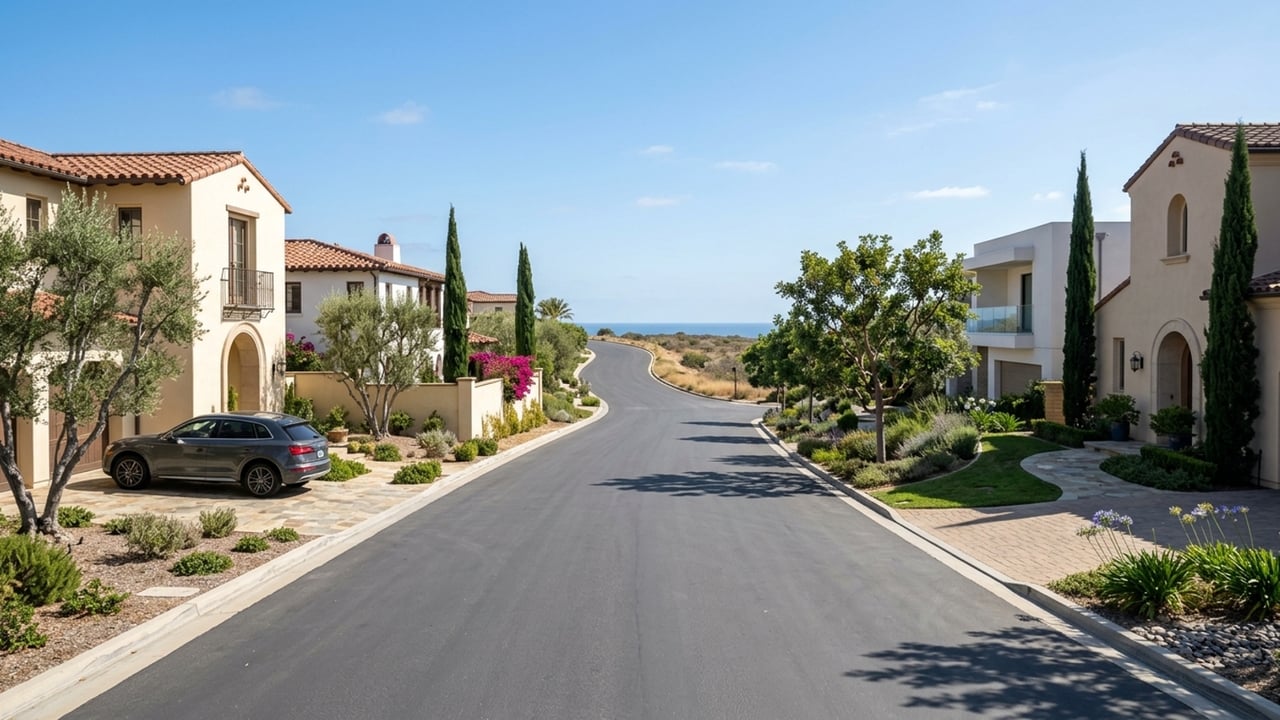
Newport Coast sits within Newport Beach, CA, but it operates like its own world - master-planned luxury enclaves, large lots, ocean proximity, and price tags that make even seasoned buyers pause. It consistently ranks among the best neighborhoods in Newport Beach. If you're looking at homes for sale here, you're looking at a different market than the broader city.
The broader Newport Beach housing market recently saw a median sale price of roughly $3.84 million, with homes spending an average of 63 days on the market. Newport Coast routinely exceeds that by a significant margin. Understanding the pricing, the HOA structures, and the local regulations before you start scheduling tours will save you a lot of frustration.
Newport Coast occupies the southern portion of Newport Beach, CA, running along the ocean and up into the coastal hills, with state park land as a neighbor. Residents use the same municipal services as the rest of the city - utilities, permitting, public safety, all of it flows through Newport Beach proper.
What makes this area distinct is the structure. There's no historic downtown, no main street that grew up organically over a century. It was designed with a specific master plan, and that plan is visible in everything from the street layout to the architectural guidelines. Crystal Cove State Park and the Pelican Hill Resort golf course area function as the primary landmarks for people who live here.
The community runs from the coastline back into the hills, which means a lot of properties sit at elevation - and elevation here means views. Water, canyons, or both.
The planned nature of the development matters when you're buying. Streets, residential tracts, and commercial centers were all laid out together, with unified architectural guidelines baked in. You're not going to stumble across a quirky mid-century bungalow between two modern estates.
Newport Coast residents are subject to the same municipal codes as the rest of Newport Beach - including the same short-term rental oversight that affects investment buyers across the city. Housing density here runs lower than in places like the Balboa Peninsula.
Buyers typically come here when they want larger lot sizes or newer construction than what the historic city center offers. It's quieter, more residential, and further from the commercial activity to the north.
The inventory in Newport Coast is almost entirely large single-family homes, luxury estates, and high-end attached properties. A lot of them sit behind private gates. Nearly all of them come with an active homeowner association.
Expect to pay a premium well above the $3.84 million Newport Beach median. Estimates for Newport Coast routinely exceed $5.5 million, and the upper end of the market goes considerably higher.
This is newer, master-planned construction - not historic cottages. Expansive floor plans, private pools, and multi-car garages are standard features across most of the inventory.
Because development happened in planned phases, buyers will run into multiple homeowner associations, sometimes layered on top of each other. Those HOAs cover street maintenance, landscaping, and the community security gates, and they come with monthly or quarterly dues you'll need to account for in your budget.
Getting a precise read on this sub-market is genuinely difficult because the volume of ultra-luxury sales is low enough that a single transaction can swing the numbers. That said, the data points are consistent in direction if not exact value. Zillow placed the typical home value around $5.6 million. Movoto showed a median list price of roughly $7.28 million. Redfin reported a median sale price of $6.9 million for late 2025.
Every source lands well above the $3.84 million citywide number. Budget accordingly.
Daily life here is convenient without being urban. Local commercial plazas give residents access to grocery stores, fitness centers, and everyday services without a trip into central Newport Beach.
You'll need a car. The master-planned design prioritizes residential privacy, not walkability, and most errands require driving. Major coastal highways connect the community to the rest of Orange County.
Dining options run from casual cafes in the local shopping centers to high-end restaurants at the Pelican Hill Resort. The resort's culinary options are close enough that residents use them regularly, not just on special occasions.
For weekly groceries and household items, the community's own retail centers handle most of what you need without leaving the immediate area.
There's no equivalent to the Balboa Pavilion here - Newport Coast doesn't have that kind of historic commercial anchor. What it has is Crystal Cove State Park, which delivers miles of open space and direct beach access.
For commuters, the Pacific Coast Highway and the 73 Toll Road are the main arteries heading north toward Los Angeles or south toward San Diego.
If you're moving with a family or planning to stay long-term, the practical infrastructure matters as much as the home itself. Newport Coast is well-connected to regional systems for both public education and medical care.
The climate here is what you'd expect from coastal Southern California - mild year-round, with morning marine layer that typically burns off by afternoon.
Newport Coast is served by the Newport-Mesa Unified School District, which covers Newport Beach and Costa Mesa. The local public elementary campus is Newport Coast Elementary School, serving grades K-6.
Secondary school attendance depends on your exact address. Some students in this area fall within Irvine Unified boundaries and would attend schools like University High School rather than Newport-Mesa secondary campuses. It's worth verifying your specific address before assuming which district applies.
Hoag Hospital Newport Beach, located on Hoag Drive, is the closest major facility. It's a nonprofit acute care hospital and the primary option for the immediate coastal area.
Several others sit within five to ten miles: MemorialCare Saddleback Medical Center in Laguna Hills, MemorialCare Orange Coast Medical Center in Fountain Valley, Mission Hospital-Laguna Beach, and Kaiser Permanente Orange County-Irvine Medical Center.
If you're buying as a second home or investment property with rental income in mind, you need to understand Newport Beach's regulatory framework before you close - not after.
Short-term rentals require a Short-Term Lodging Permit and a municipal business license. The city caps active permits at 1,550 total across all of Newport Beach. The annual renewal fee in 2025 was $214.
Permits are only available in specific zoning districts - R-1.5, R-2, and RM. Single-family R-1 zones are off-limits for short-term rentals entirely.
Operators must collect a 10% Transient Occupancy Tax from guests on stays under 30 days. The city also requires a minimum stay of two consecutive nights and mandates that all guests be at least 25 years old.
In February 2026, the City Council adopted Ordinance No. 2026-2, which expanded safety enhancement periods, added new limits on beach shades and umbrellas, and clarified the rules around permit suspensions.
Under current regulations, two violations of city codes or state and federal laws by any guest within a single year results in a six-month permit suspension. If you're planning to hire a property manager, make sure they know those enforcement mechanisms and take them seriously.
This is a specialized market. Properties here spend around 63 days on the market - consistent with the broader Newport Beach average - but the due diligence required for a high-value purchase with HOA layers and potential zoning considerations is more involved than a typical transaction.
A local agent can walk you through HOA documents, confirm school attendance zones for your specific address, and pull recent comparable sales in a market where the data is thin. They can also track active inventory across the wider city, which currently sits at around 403 homes for Newport Beach overall. That context matters when you're deciding how quickly to move on something you like.
Newport Coast is known for its master-planned luxury enclaves and large estate homes. The area is also defined by natural and recreational landmarks, including Crystal Cove State Park and the Pelican Hill Resort golf course.
Homes here are primarily large, newer-construction single-family properties and luxury estates, almost all within homeowner associations. Prices typically range from $5.6 million to over $7.2 million, well above the broader Newport Beach median.
The area has everyday cafes in local shopping centers and high-end culinary options at the Pelican Hill Resort. Most daily dining and grocery needs are accessible without leaving the immediate community.
Mild coastal Southern California weather year-round. Comfortable temperatures, with frequent morning marine layers that clear by the afternoon.
The primary facility is Hoag Hospital Newport Beach. Within roughly 10 miles you'll also find MemorialCare Saddleback Medical Center, MemorialCare Orange Coast Medical Center, Mission Hospital-Laguna Beach, and Kaiser Permanente Orange County-Irvine Medical Center.
The community is primarily served by the Newport-Mesa Unified School District, with younger students attending Newport Coast Elementary School. Depending on your exact address, secondary students may fall within Irvine Unified boundaries and attend schools like University High School.
Yes, but they're tightly regulated and capped at 1,550 total permits citywide. Short-term rentals are prohibited in single-family R-1 zones. Operating one requires a Short-Term Lodging Permit, a business license, and compliance with a two-night minimum stay requirement, among other rules.
Buyers looking for alternatives to master-planned luxury often compare these two parts of the broader city. The Corona del Mar neighborhood offers a different coastal lifestyle compared to the gated estates of Newport Coast. Both areas share the same municipal services and mild year-round climate.
If the high elevation and large lot sizes of Newport Coast do not fit your needs, you might consider other residential tracts within the city limits. The Dover Shores community provides another option for buyers searching the broader Newport Beach housing market. A local agent can help you compare the architectural guidelines and HOA structures across these different enclaves.
10,870 people live in Newport Coast, where the median age is 48 and the average individual income is $120,368. Data provided by the U.S. Census Bureau.
Total Population
Median Age
Population Density Population Density This is the number of people per square mile in a neighborhood.
Average individual Income
There's plenty to do around Newport Coast, including shopping, dining, nightlife, parks, and more. Data provided by Walk Score and Yelp.
Explore popular things to do in the area, including Books by Rubel, Novecento, and Karen Tucker, PGA.
| Name | Category | Distance | Reviews |
Ratings by
Yelp
|
|---|---|---|---|---|
| Shopping | 0.66 miles | 0 reviews | 0/5 stars | |
| Shopping | 1.94 miles | 0 reviews | 0/5 stars | |
| Active | 0.32 miles | 0 reviews | 0/5 stars | |
| Active | 1.37 miles | 0 reviews | 0/5 stars | |
| Active | 1.48 miles | 0 reviews | 0/5 stars | |
| Beauty | 0.32 miles | 2 reviews | 5/5 stars | |
| Beauty | 0.93 miles | 0 reviews | 0/5 stars | |
|
|
||||
|
|
||||
|
|
||||
|
|
||||
|
|
||||
|
|
Newport Coast has 4,072 households, with an average household size of 3. Data provided by the U.S. Census Bureau. Here’s what the people living in Newport Coast do for work — and how long it takes them to get there. Data provided by the U.S. Census Bureau. 10,870 people call Newport Coast home. The population density is 4,240 and the largest age group is Data provided by the U.S. Census Bureau.
Total Population
Population Density Population Density This is the number of people per square mile in a neighborhood.
Median Age
Men vs Women
Population by Age Group
0-9 Years
10-17 Years
18-24 Years
25-64 Years
65-74 Years
75+ Years
Education Level
Total Households
Average Household Size
Average individual Income
Households with Children
With Children:
Without Children:
Marital Status
Blue vs White Collar Workers
Blue Collar:
White Collar: