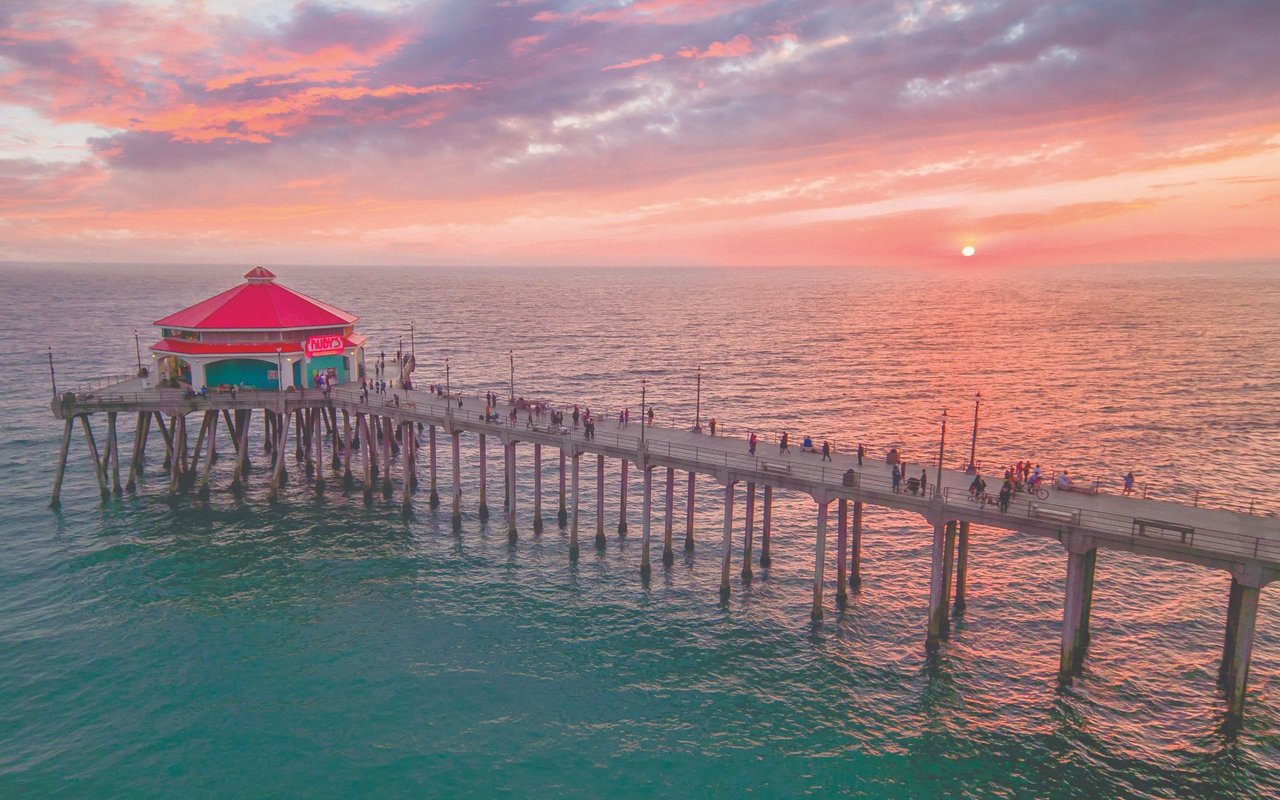
Huntington Beach is one of Orange County’s largest coastal cities, stretching from the Pacific Ocean and Huntington Harbour east into established residential neighborhoods, shopping districts, parks, and employment corridors. Known internationally for its surfing culture and long sandy shoreline, the city offers considerably more residential variety than its beachfront identity alone suggests.
Huntington Beach has approximately 9.5 miles of continuous coastline encompassing Sunset Beach, Bolsa Chica State Beach, Huntington City Beach, and Huntington State Beach. The Huntington Beach Pier, Downtown, Pacific Coast Highway, Huntington Harbour, and Bolsa Chica wetlands help define the western edge of the city, while residential communities extend several miles inland.
For home buyers, that geography creates several distinct real-estate markets. An ocean-view home near Downtown, a waterfront property with a private dock in Huntington Harbour, an established residence in Seacliff, and a single-family home farther inland may all carry a Huntington Beach address but offer very different lifestyles, ownership considerations, and values.
Understanding those differences is more useful than treating Huntington Beach as one uniform coastal housing market.
Huntington Beach offers a broad mix of housing, including oceanfront homes, custom waterfront estates, detached single-family residences, townhomes, condominiums, newer luxury communities, and established neighborhoods developed across several decades.
Location remains one of the strongest drivers of value. Proximity to the ocean, water frontage, harbour access, views, lot size, neighborhood character, renovation history, and property condition can create substantial differences between homes with similar square footage.
The city’s scale also matters. Buyers searching exclusively near Pacific Coast Highway encounter a very different inventory pool from those looking east of Goldenwest Street, around Huntington Harbour, or near the Bolsa Chica wetlands.
The qualities that are difficult to reproduce tend to matter most.
For coastal properties, ocean proximity, views, walkability to the beach, and lot position can command premiums. In Huntington Harbour, frontage, dock configuration, channel location, orientation, and boating access become central to valuation.
Elsewhere, buyers may prioritize larger lots, quiet interior streets, remodeled interiors, single-level floor plans, garages, outdoor living space, neighborhood amenities, or proximity to parks and schools.
A home should therefore be compared with properties serving the same type of buyer. Citywide price-per-square-foot figures can be useful context, but they rarely explain the full value difference between waterfront, coastal, and inland Huntington Beach real estate.
One of the most useful early decisions for a Huntington Beach buyer is how important immediate coastal access is.
Living near Downtown or the beach can place the ocean, pier, restaurants, shopping, and bike path within walking or cycling distance. Those locations may also come with smaller lots, greater visitor activity, parking considerations, and higher coastal premiums.
Moving inland generally creates a different tradeoff. Buyers may find quieter residential settings, larger lots, different architectural styles, and more housing choices while remaining relatively close to the coast.
Neither environment defines Huntington Beach by itself. The breadth between them is one of the city's biggest real-estate advantages.
Huntington Beach developed over many decades, producing a housing stock that ranges from mid-century subdivisions and beach cottages to contemporary custom homes and major waterfront estates.
That history is visible from neighborhood to neighborhood. Some streets retain much of their original residential character, while others have experienced substantial remodeling, additions, or complete redevelopment.
The areas closest to the beach include condominiums, townhomes, detached residences, custom homes, and properties positioned directly along or near Pacific Coast Highway.
Downtown places residents near the Huntington Beach Pier, Main Street, Pacific City, restaurants, shopping, and the shoreline. The housing becomes increasingly residential as streets extend inland from the beach, creating a mix of coastal access and neighborhood living.
For buyers, proximity to the ocean should be evaluated alongside practical considerations such as parking, visitor activity, lot configuration, salt-air exposure, outdoor space, and the property's exact relationship to Pacific Coast Highway and the beach.
Huntington Harbour provides one of Huntington Beach’s most specialized real-estate markets.
Built beginning in the 1960s in the city’s northwest corner, the Harbour contains five man-made islands and more than 500 bayfront homes. Residential waterways support boating, kayaking, paddleboarding, and other harbour recreation in a protected setting that feels distinctly different from the open Pacific coastline.
Housing ranges from major detached estates with private docks to townhomes and condominium communities positioned along channels and lagoons.
TSREG has represented this diversity directly, including waterfront townhomes such as 3842 Montego Drive in Seagate, where lagoon frontage provides backyard access for paddleboarding, kayaking, and small sailing craft.
Much of Huntington Beach consists of established single-family neighborhoods located between the coastline and the city’s eastern boundary.
These areas can offer residential streets, yards, two-car garages, parks, and homes spanning multiple generations of Southern California architecture. Some properties remain relatively close to their original construction, while others have undergone significant renovations or additions.
For buyers who want Huntington Beach access without paying specifically for ocean views or water frontage, these neighborhoods can provide a wider spectrum of price points, lot sizes, and housing choices.
Huntington Beach does not function like a city divided into formally planned villages. Instead, buyers often orient themselves around recognizable districts and communities defined by geography, coastline, waterways, development era, and nearby amenities.
A productive home search usually means identifying several of these areas before comparing individual properties.
Downtown is the most recognizable version of Huntington Beach.
The Huntington Beach Pier anchors the coastline, with Main Street, Fifth Street, Pacific City, restaurants, shops, hotels, and beach activity concentrated nearby. Huntington Beach’s visitor bureau describes the Pier, Main Street, Fifth & PCH, and Pacific City as central elements of the Downtown area.
Residential streets immediately beyond the commercial core create opportunities to live close to the beach while retaining a neighborhood setting.
For buyers who place a premium on walking or cycling to the ocean and Downtown amenities, this can be one of the city’s most compelling locations. Buyers seeking more separation from tourism and event activity may prefer communities farther north, south, or inland.
North of Downtown, the Seacliff area offers established residential communities near the coast, parks, and recreational amenities.
Farther northwest, Brightwater occupies the Bolsa Chica Mesa near the wetlands. The City’s planning documents identify Brightwater as a distinct residential planning area developed on land overlooking or adjoining the Bolsa Chica landscape.
These northern coastal neighborhoods appeal to buyers who want proximity to the ocean and open space without necessarily living within Downtown.
The relationship to Bolsa Chica is particularly distinctive. Wetlands, trails, wildlife habitat, and broad open views create a landscape uncommon elsewhere along the highly developed Orange County coast.
Huntington Harbour and Sunset Beach create another distinctive northern coastal environment.
The Harbour is organized around channels, islands, marinas, docks, and waterfront residences, while Sunset Beach occupies a narrow strip between the Pacific Ocean and Huntington Harbour.
Sunset Beach extends roughly 1.2 miles between Seal Beach and Bolsa Chica State Beach and includes beachfront residences, homes along interior streets, mixed residential-commercial property along Pacific Coast Highway, and residences near Sunset Island. The community was established in the early 1900s and retains a physical pattern quite different from central Huntington Beach.
For buyers, this area can offer an intimate coastal setting while remaining connected to the larger Huntington Beach market.
The beach is not simply a visitor attraction in Huntington Beach; it shapes the city’s geography, identity, recreation, and real estate.
Approximately 9.5 miles of contiguous sandy beach extend along the city, accompanied by a multi-use coastal trail used for cycling, walking, running, and beach access. Swimming, surfing, fishing, volleyball, and major sporting and cultural events are all part of the coastline's year-round use.
That coastal infrastructure allows beach access to influence neighborhoods beyond the homes located directly on Pacific Coast Highway.
The Huntington Beach Pier is the city’s visual and cultural anchor, extending from Downtown into the Pacific.
For nearby homeowners, the combination of beach, pier, restaurants, shops, events, and bike access creates a highly active coastal environment.
The tradeoff is that proximity to one of Orange County’s most visited beaches also means seasonal visitors and major events can affect traffic, parking, and the general pace of the Downtown area.
Buyers considering a primary residence near the coast should experience the neighborhood at different times—including busy summer weekends—rather than evaluating it only during a quiet showing.
At the northern end of the city, Bolsa Chica introduces a very different coastal experience.
The wetlands and surrounding protected areas create habitat, open views, trails, and separation between residential development and the coast. Visit Huntington Beach describes the Bolsa Chica Ecological Reserve as approximately 1,300 acres of wetlands with roughly five miles of trails.
For nearby neighborhoods, that protected landscape can be as important to the residential environment as direct beach proximity.
Waterfront ownership in Huntington Harbour requires its own layer of evaluation.
Two harbour homes can have similar square footage while offering very different boating utility depending on channel width, dock dimensions, frontage, orientation, bridge or navigational considerations, and the individual vessel a buyer intends to keep.
That makes the water component part of the property itself rather than simply a view amenity.
Some Huntington Harbour residences have private docks or direct dock access, while others overlook waterways without the same boating rights.
Dock improvements are subject to rules governing their placement and configuration. City records identify established pierhead and wharfage boundaries within Huntington Harbour, meaning buyers should verify the permitted condition and usable dimensions of an existing dock rather than relying solely on marketing descriptions.
Buyers should also evaluate bulkheads or waterfront improvements where applicable, along with maintenance responsibilities and the physical condition of any dock infrastructure.
Harbourfront and ocean-oriented properties offer fundamentally different coastal experiences.
An oceanfront or near-ocean residence emphasizes beach access, surf, sunsets, and the energy of the open coastline.
A Huntington Harbour home emphasizes protected waterways, docks, boating, paddleboarding, and a residential marine environment.
For buyers who know they want waterfront living, determining how they want to use the water can narrow the search considerably.
School assignments in Huntington Beach require more attention than the city name alone suggests.
Huntington Beach Union High School District serves grades 9–12 across the broader area, while four separate elementary districts serve portions of the same geography: Huntington Beach City School District, Ocean View School District, Fountain Valley School District, and Westminster School District.
That means buyers should verify the district and individual school serving a specific address rather than assuming every Huntington Beach home follows the same pathway.
Huntington Beach City School District currently operates six elementary schools and two middle schools, including Seacliff, Smith, Peterson, Moffett, Hawes and Eader elementary schools and Dwyer and Sowers middle schools.
Other Huntington Beach addresses may fall within another elementary district.
For buyers making a decision based partly on school assignment, the safest approach is to use the appropriate district’s current school locator for the exact property before making an offer. District boundaries and attendance areas should not be inferred from a neighborhood name or an older real-estate listing.
Huntington Beach occupies a central stretch of coastal Orange County between Seal Beach and Newport Beach, with Costa Mesa and Fountain Valley immediately inland.
Pacific Coast Highway provides north-south coastal access, while Beach Boulevard, Goldenwest Street, Warner Avenue, Adams Avenue, and other major corridors connect residential neighborhoods with inland Orange County.
The city’s long east-west footprint means commute patterns can vary considerably depending on where a home is located.
A home near Downtown may optimize beach access while placing a resident farther from the freeway system.
An inland Huntington Beach neighborhood may sacrifice immediate walking access to the ocean but provide a more direct route toward I-405 and Orange County employment centers.
Huntington Harbour and Sunset Beach create another pattern entirely, with convenient coastal connections toward Seal Beach and Long Beach but a different relationship to central Orange County.
For buyers who commute regularly, those differences are worth testing during the actual hours they expect to travel.
Buying in Huntington Beach begins with deciding which version of coastal living matters most.
Is the priority walking to the beach? A private boat dock? Backing to open space? A quieter established neighborhood? A larger lot? Newer construction? Proximity to Downtown? Those choices quickly separate the city into more useful micro-markets.
From there, evaluate the attributes that cannot easily be changed: lot, location, waterfront position, view, orientation, neighborhood setting, and association structure.
Coastal property requires additional attention to location-specific conditions.
Salt air and moisture can affect exterior materials, windows, roofs, railings, mechanical equipment, and other building components. Waterfront properties add dock, bulkhead, and harbour considerations.
Flood exposure also varies within Huntington Beach. City planning documents identify coastal, wetland, channel, and other portions of Huntington Beach within mapped flood-hazard areas and specifically recommend evaluating property-level flood conditions rather than making citywide assumptions.
Buyers should review current natural-hazard disclosures, insurance availability, FEMA information where applicable, and property-specific inspections during due diligence.
An experienced Huntington Beach real estate agent should understand why value changes from Downtown to Seacliff, Huntington Harbour, Sunset Beach, Brightwater, and inland neighborhoods.
For waterfront purchases, that expertise should extend to frontage, dock utility, channels, association structure, and the specialized comparable sales relevant to harbour property.
Tim Smith Real Estate Group has represented Huntington Beach properties across multiple market segments, including harbour-front residences and established inland homes. TSREG’s experience ranges from lagoon-front property in Seagate to single-family transactions elsewhere within Huntington Beach, providing context beyond one narrow portion of the city.
Huntington Beach offers oceanfront and near-ocean residences, waterfront homes with private docks, custom estates, detached single-family homes, condominiums, townhomes, and properties in both established and newer communities. Housing varies considerably between the coastline, Huntington Harbour, and inland neighborhoods.
Yes. Huntington Harbour includes bayfront residences with private docks as well as townhomes and condominiums with varying forms of water and dock access. Dock dimensions and boating capability differ by property and should be verified individually.
Downtown is oriented toward the Pacific Ocean, Huntington Beach Pier, Main Street, beach recreation, restaurants, and shopping. Huntington Harbour is a residential network of protected waterways and islands where boating, docks, kayaking, and paddleboarding are central to the setting.
Yes. Sunset Beach is a distinct coastal community within the City of Huntington Beach. It lies between Seal Beach and Bolsa Chica State Beach, with the Pacific Ocean on one side and Huntington Harbour developments nearby on the other.
Start with location and the home’s relationship to the coast. Compare ocean or harbour access, views, waterfront frontage where applicable, lot size, neighborhood character, property condition, renovation history, HOA obligations, insurance considerations, and commute patterns.
196,010 people live in Huntington Beach, where the median age is 43.4 and the average individual income is $62,450. Data provided by the U.S. Census Bureau.
Total Population
Median Age
Population Density Population Density This is the number of people per square mile in a neighborhood.
Average individual Income
There's plenty to do around Huntington Beach, including shopping, dining, nightlife, parks, and more. Data provided by Walk Score and Yelp.
Explore popular things to do in the area, including Entertainment Cafe, Vingate Clothing and Gifts, and Atlas Stone Fitness.
| Name | Category | Distance | Reviews |
Ratings by
Yelp
|
|---|---|---|---|---|
| Shopping | 0.93 miles | 0 reviews | 0/5 stars | |
| Shopping | 0.94 miles | 0 reviews | 0/5 stars | |
| Active | 0.25 miles | 0 reviews | 0/5 stars | |
| Active | 0.73 miles | 0 reviews | 0/5 stars | |
| Active | 1.02 miles | 0 reviews | 0/5 stars | |
| Beauty | 0.54 miles | 9 reviews | 3.2/5 stars | |
| Beauty | 0.63 miles | 0 reviews | 0/5 stars | |
| Beauty | 0.68 miles | 0 reviews | 0/5 stars | |
| Beauty | 0.68 miles | 0 reviews | 0/5 stars | |
| Beauty | 0.69 miles | 0 reviews | 0/5 stars | |
| Beauty | 0.69 miles | 0 reviews | 0/5 stars | |
| Beauty | 0.69 miles | 7 reviews | 5/5 stars | |
| Beauty | 0.69 miles | 0 reviews | 0/5 stars | |
| Beauty | 0.87 miles | 0 reviews | 0/5 stars | |
| Beauty | 1 miles | 0 reviews | 0/5 stars | |
| Beauty | 1.02 miles | 1 review | 1/5 stars | |
| Beauty | 1.02 miles | 9 reviews | 5/5 stars | |
| Beauty | 1.02 miles | 1 review | 5/5 stars | |
| Beauty | 1.02 miles | 0 reviews | 0/5 stars | |
| Beauty | 1.02 miles | 0 reviews | 0/5 stars | |
| Beauty | 1.02 miles | 0 reviews | 0/5 stars | |
| Beauty | 1.02 miles | 0 reviews | 0/5 stars | |
| Beauty | 1.02 miles | 0 reviews | 0/5 stars | |
| Beauty | 1.02 miles | 0 reviews | 0/5 stars | |
|
|
||||
|
|
||||
|
|
||||
|
|
||||
|
|
||||
|
|
Huntington Beach has 77,549 households, with an average household size of 2.51. Data provided by the U.S. Census Bureau. Here’s what the people living in Huntington Beach do for work — and how long it takes them to get there. Data provided by the U.S. Census Bureau. 196,010 people call Huntington Beach home. The population density is 7,260 and the largest age group is Data provided by the U.S. Census Bureau.
Total Population
Population Density Population Density This is the number of people per square mile in a neighborhood.
Median Age
Men vs Women
Population by Age Group
0-9 Years
10-17 Years
18-24 Years
25-64 Years
65-74 Years
75+ Years
Education Level
Total Households
Average Household Size
Average individual Income
Households with Children
With Children:
Without Children:
Marital Status
Blue vs White Collar Workers
Blue Collar:
White Collar: